Hjemsøkte ruiner i Sverige
Sverige · Ruin
Det finnes steder i Sverige der vinden synes å bære på hvisken fra en svunnen tid. Der murer som en gang beskyttet konger, klosterbrødre og slottsfruer nå står i stillhet, men langt fra forlatte.
Haunted ruins in Sweden
There are places in Sweden where the wind seems to carry whispers from a vanished age. Where walls that once sheltered kings, monks and noblewomen now stand in silence — but far from abandoned. These ruins, whose stones hold memories of fire, blood and curses, attract not only historians but also those drawn to the supernatural. Among the fallen vaults, spirits are said to walk. Monks. Maidens. Warriors. The Devil himself.
What is a ruin?
A ruin is what remains of a former building that has partly or wholly collapsed or been destroyed — often through war, fire, decay or abandonment. In Sweden this can mean anything from monasteries, fortresses and castles to manor houses and hunting lodges. But ruins are more than remnants of stone: they are portals to the past, full of the stories that shaped a country's history.
Visiting ruins — some advice
Walking through a ruin can be both a historical and an emotional experience. A few things worth keeping in mind:
Respect the site. Many ruins are protected ancient monuments under Swedish law.
Do not go alone, particularly after dark. Not only because it can be frightening — safety matters.
Bring a torch and a camera. You never know what you might capture.
Check for local guides. Many ruins have ghost walks or associated stories.
Watch your footing. Ruins can be slippery and uneven, and often lack railings.
Where to find ruins in Sweden
From the Halland coast to the Östergötland plain, in forests, by lakes and on cliffs — ruins are found across Sweden. Many are easily reached by car or hiking trail, and several are marked on tourist maps. Look for names containing slottsruin (castle ruin), klosterruin (monastery ruin) or fornborg (hill fort). The most interesting are often found through tips from local people.
1. Falkenberg fortress ruin — the eternal vigil of the Ätran maiden
At the mouth of the Ätran river in Halland stand the remains of Falkenberg fortress. Once a strategic stronghold on Denmark's northern border, it is now a place where history meets legend. The fortress was destroyed during Engelbrekt's revolt in 1434, but its mystery lives on — not least through the legend of the Ätran maiden.
When the enemy approached, a young woman hid in an underground passage with the fortress treasure. The passage collapsed. She died there, but is said to still guard the treasure in the form of a cockerel that crows if the town of Falkenberg is threatened. Near the ruin stands the sculpture Skattvårderskan, the treasure keeper, and according to local tradition her spirit lives on in the wind by the Ätran.
2. Mörby castle ruin — the castle the Devil helped build
In Uppland, Mörby castle ruin rises as a place where love, jealousy and demonic forces meet. According to legend the Devil himself helped build the castle. Five ghosts are said to walk among the fallen walls today.
Rumour speaks in particular of a black dog with glowing eyes — one of the Devil's forms. Others describe the White Lady searching for her drowned love, the Blue Maiden, a kidnapped princess, the remorseful knight Myre who became a monk, and a woman in black whose heart never healed.
At dusk their stories are whispered on the wind.
3. Gräfsnäs castle ruin — curses, ghosts and treasure
Gräfsnäs castle burned down three times: in 1634, in 1734 and in 1834. An exactly hundred-year curse is said to rest on the place, pronounced by a despairing servant woman who cursed the harsh countess Ebba Lilliehöök. After the last fire the castle was never rebuilt — perhaps because the curse made it impossible.
Skeletons walled in, hidden passages and stories of an unseen treasure make the ruin a magnet for adventurers. Paranormal phenomena including voices, footsteps, orbs and the smell of burning have been reported despite the site standing deserted. Ghost hunters have even recorded electronic voice phenomena in which voices whisper in the emptiness.
Some say the curse still rests here.
4. Alvastra monastery ruin — where the monks' voices still carry
At the foot of Omberg in Ödeshög lies the Alvastra monastery ruin: beautiful, peaceful and reputedly haunted. Founded by Cistercian monks in 1143, the monastery was once a centre of religion and innovation. Today it is a place of spirituality — and of cold shivers.
Many have heard organ music drifting through the night, seen grey-clad figures vanish without trace, and felt followed. Ghost hunters have recorded voices in Latin — the monks' language — and even communicated with a spirit calling itself Abbot.
At Alvastra the spiritual force of history can be felt, and perhaps something darker and more persistent.
5. George Seaton's hunting lodge — a dream turned to ash
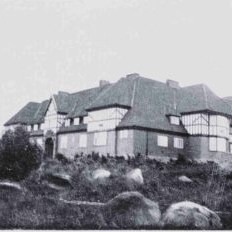
High above Öresjön, on Hyltenäs hill in Mark municipality, stand the ruins of George Seaton's hunting lodge. Built in 1916 in an explosion of splendour, it burned down after only seven years. But the ruins live on, and with them the stories.
Visitors describe the sense of being watched. Shadows in the forest. Voices on the wind. Is it Seaton himself, who never let go of his vision? Or is it simply the history of the place playing tricks on our senses?
A final whisper
Ruins are more than stone and history. They are vessels for human dreams, fears — and sometimes souls. Perhaps that is why they haunt us. Or perhaps it is we who haunt them, with our curiosity, our questions and our longing to understand what we cannot see.
Opplysningene bygger på lokal folketro og vitneskildringer.
Image: Svenska Spökkartan (Facebook)