Krapperups Slot — den hvide frue og hundredårscyklussen
Skåne · Sverige · Castle
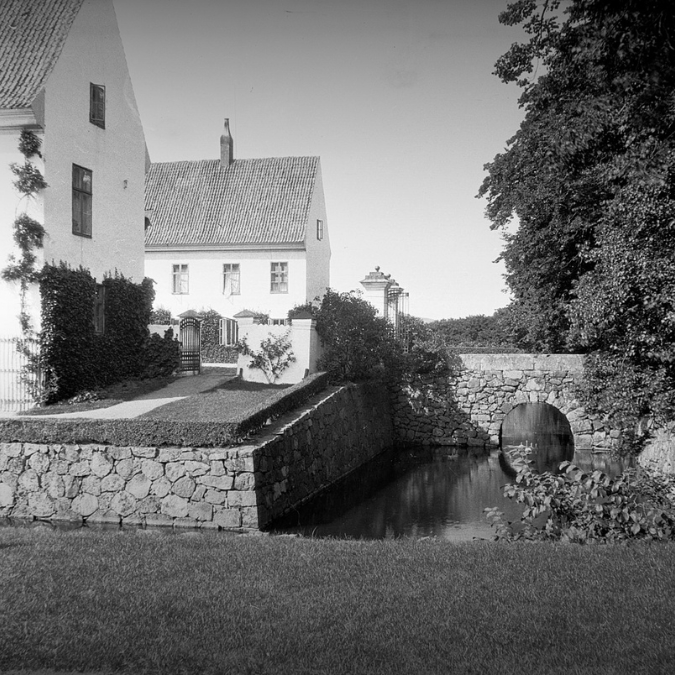
På Kullahalvön i det nordvestlige Skåne, få kilometer fra Mölle, rejser sig Krapperups Slot. Med sin voldgrav, sine tykke mure og sin romantiske park med rislende bække og eksotiske træer føles det som at træde ind i en eventyr.
Krapperup Castle — the White Lady and the hundred-year cycle
On the Kulla peninsula in north-western Skåne, a few kilometres from Mölle, rises Krapperup Castle. With its moat, thick walls and romantic park of running streams and exotic trees, it feels like stepping into a fairy tale. It is no surprise the place is listed as a sight worth seeing by the Michelin guide. But behind the idyllic façade lies a history of blood, madness and a curious curse.
A fortress with roots in the 1300s
Krapperup is one of Skåne's oldest manorial estates, mentioned in documents as early as the 1200s when the Krognos family owned the fortress. In the mid-1300s the knight Johannes Jonaesson — Jens Jenssøn in Danish — had a rectangular stone house with a banqueting hall built here. Around the main building came kitchens, stores and stables. A curtain wall, gate tower and moat followed, with a drawbridge connecting the fortress to the outside world. While the Krognos family dominated the Kulla district, cattle rearing and grain growing were important to the estate's economy: barley was grown on the Skåne plain and cattle grazed the common pastures. Later, in the 1500s, the old fortress was demolished and replaced by a Renaissance castle in brick, with the octagonal tower in the south-eastern corner that still stands today.
Ownership has changed many times. The Podebusk family took over in the 1500s, followed by the Swedish countess Maria Sofia De la Gardie, who restored the castle and replaced roofs, wings and interiors in baroque style during her time. In the 1700s the castle was rebuilt in rococo, and under Petter Gotthard von Kochen the great staircase and the reception floor were added. Modernisation continued through the 1800s and 1900s: land was drained, feudal labour obligations abolished and farming made more efficient. When the entailed-estate holder Gustaf Gyllenstierna had no male heirs, he transferred the castle in 1967 to the Gyllenstierna Krapperup Foundation. The old farm buildings around the inner courtyard are now used as an art hall, estate shop and music hall. The old smithy houses a café and shop, and the cattle barn serves as a concert venue.
So far, a conventional estate history. It is here that the supernatural side begins.
The White Lady and the mirror behind the portrait
According to a legend circulated among others by Myling.se, a woman in white walks the castle's corridors every New Year's night. She stops before a portrait of Nils Gyllenstierna, lifts the frame and looks at herself in a mirror said to be hidden behind the painting. No one knows why she must see her reflection on that particular night, but if the painting or the mirror should fall, someone in the family is said to die. The legend speaks of a curse that strikes once each century — a hundred-year cycle of tragedies.
The tradition holds that in the 1500s a lord of the castle was murdered out of jealousy. In the 1600s a lady of the house went mad, strangling her servants in their sleep before being locked in the attic herself. In the 1700s a post rider carrying important letters is said to have been murdered at the gate tower. The White Lady is said to be a noblewoman who found no peace in the grave. Perhaps she is connected to one of these crimes and wishes to remind the family of guilt and responsibility. Each New Year's night she moves through the portrait gallery, carefully lifting the painting and studying herself in the mirror. If the frame falls, death follows in the family.
Several visitors and employees have described strange experiences. A guide recounted standing and talking about the Gyllenstierna portrait when she felt an icy cold at the back of her neck. At the same moment one of the candles in the chandelier fell. A few months later an elderly family member died. A gardener described hearing the fabric of a dress dragging across the stone floor in the corridor; when he turned, no one was there. A night watchman saw a figure in white sitting by the pond in the park with its head bowed, as if in grief. When he approached, the grass was wet although it had not rained.
It is also said that the ghost's appearance is followed by a series of strange coincidences. Someone on the staff catches the bread knife and cuts themselves; an old book topples open at lines about death. Whatever the truth, the tradition has created a mysterious aura around New Year's night at Krapperup. The foundation takes no chances: staff keep watch in the hall each New Year to see whether the frame moves. And no one is allowed to touch the portrait.
Ghost walks at Krapperup
Krapperup's romantic park is open to the public, and in summer there are concerts, art exhibitions and guided tours. In autumn, ghost walks are also arranged. Guides tell of the castle's darker side — of the mad lady of the house who believed the servants were demons, of the dark bloodstain in the cellar that cannot be washed away, and of the monks said to walk by the moat. Visitors are shown the coldest parts of the castle, where you sometimes feel someone pass although the room is empty. The brave can stay until midnight on New Year's Eve to see whether the White Lady appears.
There is something compelling about so beautiful an estate carrying such dark stories. Perhaps it is precisely the contrast between rhododendron beds and death curses that makes Krapperup remarkable. Danish medieval history, Swedish baroque, romantic garden design and ghost lore all meet here, framed by a moat that reflects the sky and, perhaps, something else.
FAQ
Hvor ligger Krapperups Slot — den hvide frue og hundredårscyklussen?
Krapperups Slot — den hvide frue og hundredårscyklussen ligger i Skåne, Sverige.
Oplysningerne bygger på lokal folketro og vidneberetninger.
Image: spokkartan.se