Den hovedløse kusk på Göholms gods
Blekinge · Sverige · Cemetery
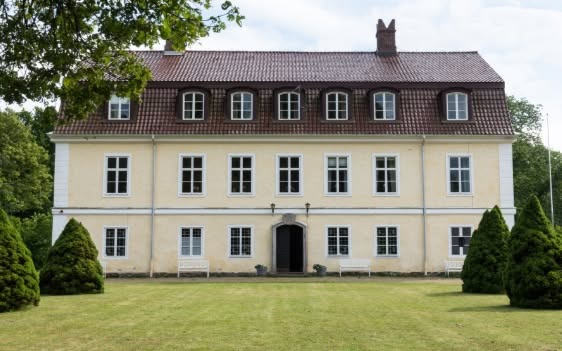
Langs Blekinges kyst, lige sydøst for Ronneby, knejser Göholms gods på Göhalvön. Det er et sted med en lang og dramatisk historie — men også et af Blekinges mest omtalte hjemsøgte steder.
The headless coachman of Göholm estate
Along the Blekinge coast, just south-east of Ronneby, Göholm estate rises on the Gö peninsula. It is a place with a long and dramatic history — and one of the most talked-about haunted sites in Blekinge. Johan af Puke himself, the legendary admiral and count, is said to still haunt his former property.
The most frightening account? A black carriage drawn by four coal-black horses rolls through the night. On the box sits a driver — without a head. And in the carriage, none other than Johan af Puke, on an endless journey through his old lands.
"Count Puke hitched a ride with me"
The legend of Göholm has been passed down for generations. A farmer who leased land from the last private owner, Miss Stina Werner, refused to drive his tractor through the estate after dark. He claimed that Count Puke rode along with him, unseen but present: an oppressive feeling, an icy gust, a shadow at the edge of vision — all signs that something beyond explanation was travelling with him.
Puke is not alone on the estate. Several accounts describe a mysterious woman in blue who walks through the building and the park. No one knows with certainty who she is — perhaps a forgotten soul from somewhere in the estate's history.
From humble beginnings to admiral and count
Johan af Puke's life was dramatic by any measure. Born in Ronneby in 1751 as an illegitimate son, he had a hard start. His father, Captain Johannes Puke, was executed for his part in Queen Lovisa Ulrika's failed coup attempt of 1755. Johan grew up in poverty but worked his way up through the navy. He served in the French, Dutch and English fleets before becoming a key figure in Gustav III's Russian war.
His successes led to his ennoblement as "af Puke" in 1797, and later to the titles of baron and count. In 1790 he bought Göholm and built the imposing manor house that still stands today. Even after his death in 1816, he does not appear to have left the place.
Göholm through the centuries
Göholm has a long history. The village of Gö is mentioned as early as the 1200s in King Valdemar's land register. During the Danish period the area belonged to the powerful Bielke family, before being taken by the Crown and later returning to private hands.
The present main building was raised in 1799 by Johan af Puke himself. Above the entrance the inscription can still be read: "Built by Rear Admiral Johan Puke in the year 1799."
After Puke's death the estate passed down through the family, but was eventually taken over by Stina Werner, who bequeathed it to a foundation for research in agriculture and nature conservation. The land is now managed by Skogssällskapet, and the Blekinge agricultural college uses part of it for teaching.
The Puke burial chapel
A short distance from the main building stands the Puke family burial chapel, where Johan af Puke and his family rest. The chapel is built from timber taken from his old ship of the line, Dristigheten, once part of the Swedish fleet — a symbolic link between his life at sea and his final resting place.
But can he truly rest in peace?
Accounts of strange lights, unexplained sounds and sudden drops in temperature have made the burial chapel another place where Puke's spirit is said to appear. Some claim you can hear voices in the wind, if you listen closely enough.
FAQ
Hvor ligger Den hovedløse kusk på Göholms gods?
Den hovedløse kusk på Göholms gods ligger i Blekinge, Sverige.
Oplysningerne bygger på lokal folketro og vidneberetninger.
Image: Svenska Spökkartan (Facebook)